Statement of facts
Industry
Maritime
Client
Zodiac Maritime
Service
Product design/ UX
Date
2023
The Statement of Facts (SoF) is a critical document used in maritime operations to record key events during a vessel’s time in port. Despite its importance, the process was still largely manual, relying on paper logs and inconsistent digital tracking.
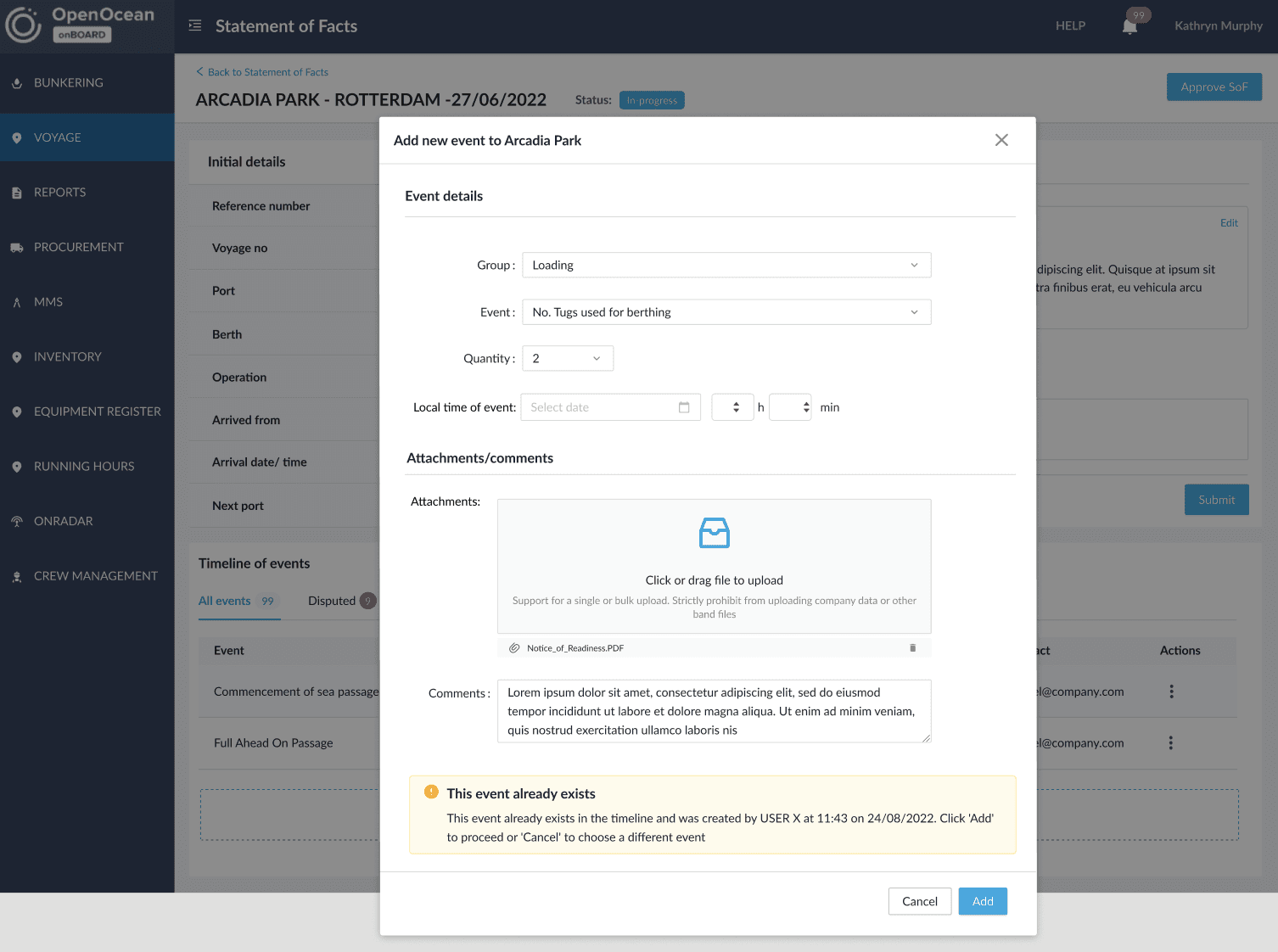
This project involved designing the SoF experience from scratch — translating a complex, domain-heavy workflow into a structured, digital interface that supports accurate data capture, compliance, and reporting.

Research
As there was no existing digital product, I focused on building a deep understanding of the workflow before designing any interfaces.
I worked closely with the SME in port operations to map out how SoF data is recorded in real-world scenarios — including what events are captured, when they occur, and how they are used for compliance and claims.
I also reviewed traditional paper logs and spoke with both onboard crew and shore-based staff to understand the challenges in the current process.
This revealed several key issues:
Data was often re-entered across systems, increasing the risk of errors
There was little guidance on what needed to be recorded and when
Information was inconsistently structured, making reporting and validation difficult
Mapping this into structured user journeys helped define:
Core data requirements
Logical groupings of events
A clear sequence for how reports should be completed
These insights directly informed how the digital experience was structured, ensuring it aligned with real operational workflows rather than forcing users into a rigid system.
Personas
To ensure the product supported all users involved in the process, I worked with the SME and stakeholders to identify key user groups:
Crew members responsible for capturing events in real time
Port agents and shore-based teams reviewing and validating reports
This highlighted a critical balance:
Crew needed speed, clarity, and minimal friction during data entry
Shore-based users needed structured, reliable data for compliance and reporting
These differences shaped key design decisions around workflow structure, data validation, and how guidance was surfaced within the interface.

User flows
With no existing digital flow to build on, I mapped the full lifecycle of a port call, from arrival through each recorded event to final sign-off.
Working closely with the SME and port operations staff, I captured the real-world sequence of actions and decision points, including delays, corrections, and approvals.
This exposed where the system needed clearer structure, guidance, and validation. I translated these into structured flow diagrams that defined how the feature should behave across different scenarios.
These flows became a shared reference across design, product, and engineering, helping the team align on core logic early, reduce ambiguity, and ensure the final design supported both efficient data capture and accurate reporting.